Post-Mortem: OST Composing Jam 9
This is the third jam in my Five-Jam Gauntlet from mid August 2026 to the end of September 2026. You can read the first and second jam post-mortems if you haven’t (and want to do so).
I participated in a few previous OST (Original Soundtrack) Jams over the last couple years, and always have great fun. OST Composing Jam 9 was no different.
The theme this time around was “Songs of a Forgotten World” with the picture theme by user silverpeel. With music jams, I always try to do something new to me: a style or genre I don’t typically compose in, changing something about my compositional process, learning a new production/mixing technique - anything different is fair game.
For OST Jam 9, springboarding from both the text and image themes, I decided to run in the direction of Celtic folk music (the fiddle and the lute in the artwork were a must). I had never composed Celtic or Celtic-adjacent music before, and this was a great excuse to not only write for folk instruments but also break out a handful of obscure virtual instruments I have on my computer which I’ve never used before. Fun stuff!
While the OST Jams are usually about creating a soundtrack for a fictitious game, this time I mostly abandoned that idea in favor of focusing on telling a story through the music (one of my strong points based on feedback from past composing jams). This time around, ironing out the story was rather challenging: I knew what I wanted to tell but not necessarily how to go about telling it. Instead of the details, I “zoomed out” and shifted my focus to the emotional side of the story. After all, emotion is what drives any story. The process smoothed out from here.
The story I chiseled out is about a young boy who, while exploring the countryside, finds an old and abandoned cottage. Inside the cottage he comes upon a worn journal that belonged to a druid, and written in the journal are several melodies. The boy plays a couple of the melodies, but nothing seems to happen - until the fey spirits of nature appear in a whirl of joy and merriment at being summoned after so long!
Plenty of emotion there to work with!
I set to work constructing the themes, keeping in mind both the emotional journey AND the Celtic folk genre. It didn’t take me long to write the themes - maybe a couple of hours total for three main themes and a couple variations. I then decided how many individual compositions I would need to tell the story in brief, deciding on five short compositions.
From there I began sketching each composition, which took about two or three days (factoring in my Part-Time Day Job™ too). Sketching tends to be one of the most important steps when composing, parallel to an architect creating concept art of a new building or a baker having a recipe. The quality and detail put into a sketch will ripple into the orchestration and the production/mix, so it’s important to put care into it.
This time, mainly for the sake of workflow brevity, I opted to skip a written/notated orchestration and instead orchestrate during the production stage - a process quite outside my comfort zone (I prefer having the notation for future use and reference). But there was a solid reason for changing it up this time, and that reason is what I mentioned earlier: using virtual instruments I had not previously used.
The instruments were familiar in the sense of being folk versions of flutes and celli which is all fine and well - I just didn’t have a clear idea about which instruments I wanted to include in the whole OST nor which instruments I wanted to play which parts of the sketch. Plus, each virtual instrument tends to have its own set of quirks and, having not used most of these instruments before, I wasn’t sure what kind of quirks I’d come across.
(By “quirks” I mean artifacts on certain notes or something like a melody played back by the virtual violin sounds fine but the same melody played back by the virtual flute sounds awkward.)
Out of my element, the process became messy rather quickly. I was adding instruments, changing instruments, removing instruments, all while moving around the different parts of the sketch. Eventually in the process I found a combination of instruments that I liked and which I thought worked relatively well with the Celtic folk style I was working towards (a combination of Irish, Icelandic, and Scandinavian instruments; so not a historically-accurate Celtic folk, but more of a Hollywoodized Celtic folk).
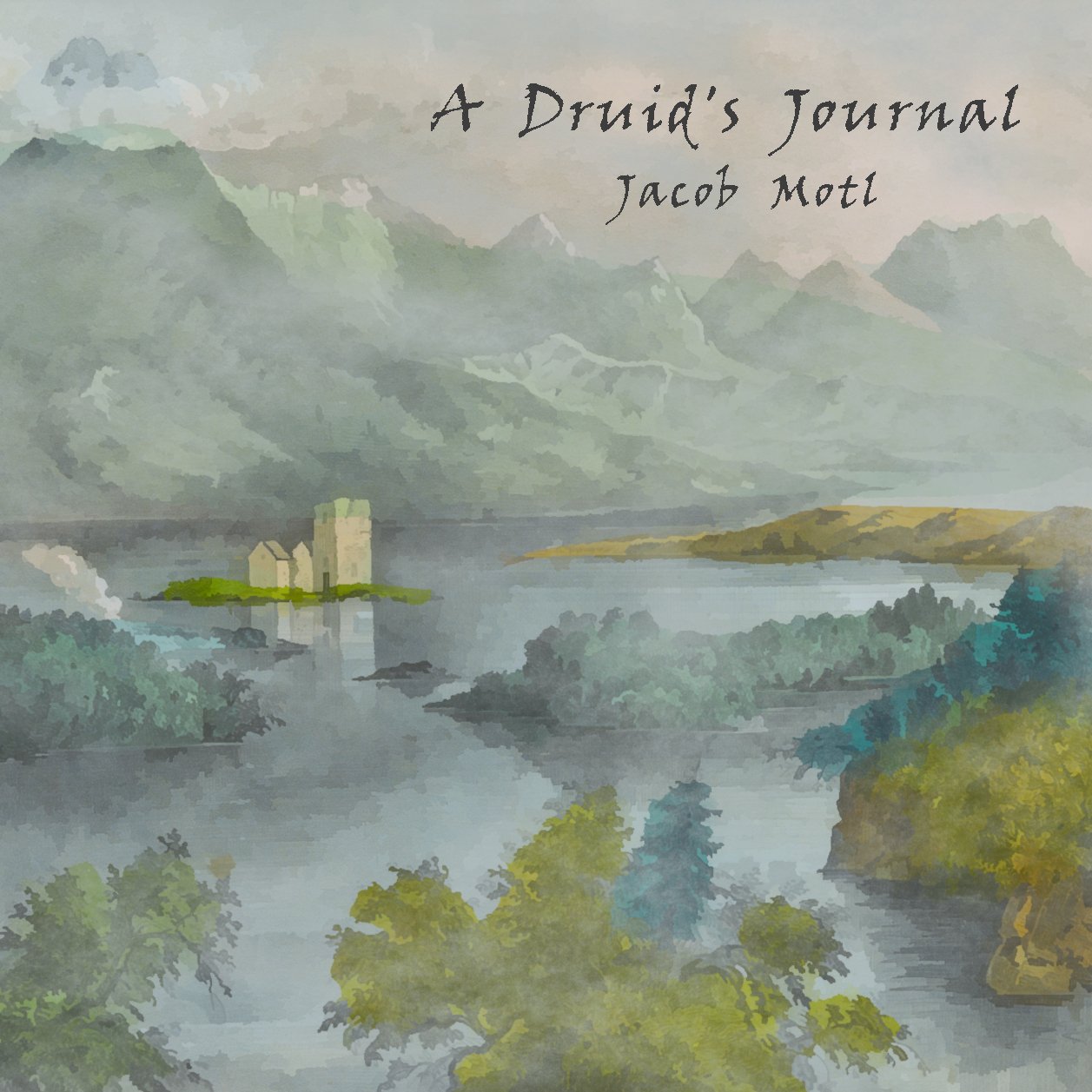
Album Art for A Druid’s Journal
Happy with the orchestration, I did a quick mix of the music. I then found a public domain image which I heavily edited for the cover art, wrote the description of the music, and submitted with nearly two days to spare on the submission window! I felt accomplished in having tried a new style, changing up my process, and testing out the instruments I haven’t had a chance to use.
For OST Jam 9, there were 200 entries. My submission, A Druid’s Journal, ranked 95th overall (top 48%), scoring 70th in Storytelling (top 35%) and 76th in Composition (top 38%).
Notice how I glazed over talking about the mixing step? Yeah, that’s because I should have spent more time on it. Whoops! Many of the written feedback I received all said as much: not that the music is bad, but what the music tries to do is held back by the mix. In hindsight (and now having learned for future jams), I should have allocated more time to mixing and sculpting the final sound. I had to submit as early as I did due to my personal schedule, but I should have factored that into the whole of my jam schedule.
Overall I’m satisfied with A Druid’s Journal and, more specifically, what I learned while creating it: changing what I do, taking risks, and exploring new elements. This is the whole point of doing jams anyway.
Following my early submission to OST Jam 9, I had about five or six days before the next (fourth) jam of the Five-Jam Gauntlet began. That will be posted soon, so stay tuned!